Subject 1: Traffic Signs, Signals & Road Markings
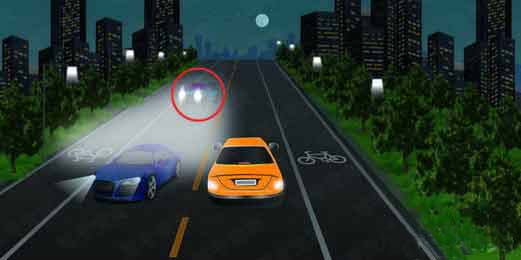
道路交通标志、标线与信号灯The way the vehicle marked in the red circle is using its lights, as shown, is correct.
红圈中标记车辆使用灯光的方法是正确的。
Question Navigator
Showing Q 1–50 of 723
Statutory Quick-Reference Index: Top 15 Traffic Signs, Signals & Road Markings Questions & Legal Citations▼ Expand Reference
Q1. The way the vehicle marked in the red circle is using its lights, as shown, is correct.
Ans: BDo not use high beams when meeting oncoming traffic at night; switch to low beams beyond 150 meters, since high beams blind the other driver.
Q2. When encountering this situation while driving, you may tap the horn lightly to alert the non-motor vehicles and pedestrians ahead that a vehicle is approaching from behind.
Ans: AA non-motor vehicle ahead is in the middle of the road, so a warning horn tap is appropriate.
Q3. When driving straight and encountering congestion ahead, a vehicle may stop temporarily to wait within the yellow grid-marked area, but must not stop on the crosswalk.
Ans: BBoth crosswalks and yellow grid no-stopping zones prohibit stopping, so vehicles must wait outside the intersection.
Q4. What the dark-colored vehicle marked by the red circle is doing, as shown, is illegal.
Ans: AYou must signal well before changing lanes, and a solid line must not be crossed.
Q5. When driving through an intersection, you must obey the traffic signals.
Ans: ATraffic signals include traffic lights, traffic signs, road markings, and police directions.
Q6. When driving in sandstorm or dusty conditions, you do not need to turn on the headlights, clearance lights, and rear position lights.
Ans: BIn sandstorm or dusty weather, you should turn on headlights, clearance lights, and rear position lights.
Q7. On this stretch of road, you may stop temporarily in the non-motor-vehicle lane.
Ans: BThe non-motor-vehicle lane is for non-motor vehicles; motor vehicles are prohibited from stopping there.
Q8. At an intersection with this sign, you should slow down and yield.
Ans: BAn octagonal sign with the character for 'Stop' means stop and yield, while a triangular 'Yield' sign means slow down and yield.
Q9. What the motor vehicle is doing as it reaches the intersection, as shown, is correct.
Ans: AThe signal shown is a round green light, which allows vehicles to go straight or turn right.
Q10. At an intersection without traffic signals, when the vehicle ahead is moving slowly, vehicles should proceed in turn, alternating.
Ans: ATraffic conditions at intersections without signals are complex, so vehicles should slow down and proceed cautiously in turn.
Q11. When the intersection ahead is congested, if there is no yellow grid marking inside it, you may stop and wait inside the intersection.
Ans: BWhen an intersection is congested, vehicles should queue and wait outside the stop line, not inside the intersection.
Q12. You may make a U-turn at this intersection.
Ans: BFollow traffic signals; safety comes first.
Q13. A motor vehicle should turn on the turn signal at the same time as it changes lanes.
Ans: BYou should signal well before changing lanes, ensuring a safe distance before actually changing.
Q14. Do not hang or place items that obstruct the driver's view within the front or rear windshield area of the cab.
Ans: AA clear view for the driver is essential to ensure safe driving.
Q15. Traffic signs and road markings are not part of traffic signals.
Ans: BSigns and markings are both used to convey traffic signals.