Decode Every Chinese Road Sign & Police Gesture by Color
Over 28% of the Subject 1 exam tests visual traffic signs, road markings, and the 8 traffic police hand gestures. Instead of guessing Chinese characters on road boards, decode any sign in 1 second using the 4-Color Statutory Matrix below.
Warning (警告): Triangles alerting hazards ahead
Prohibition (禁令): Bans, max speed & no stopping
Mandatory (指示): Required lanes & min speed
Expressway (高速): Toll exits & distance gantries
What does this solid red circle with a blank white center mean?
这个红圈白底(中间无横杠)的标志代表什么含义?
Chinese Road Signs & Highway Markings Quick-Reference Matrix
Official statutory classification of national Chinese road signs, expressway gantries, and urban street nameplates under standard GB 5768-2022:
| Category (类别) | Color & Shape (特征) | Primary Legal Meaning | Common Exam Examples | Subject 1 Test Trap |
|---|---|---|---|---|
| Warning Signs (警告标志) | Yellow Triangle + Black Border | Alerts drivers to impending hazards, sharp turns, or dangerous road geometry ahead. | Sharp Turn, Steep Descent, Pedestrian Crossing Warning, Railway Crossing. | Do not confuse with Prohibition! Yellow warns of road hazards ahead, never imposes active penalties. |
| Prohibition Signs (禁令标志) | Red Circle + White Field (+ Slash) | Prohibits specific driving behaviors, vehicle classes, stopping, or exceeding maximum speed. | No Entry, No U-Turn, No Overtaking, Maximum Speed Limit (red ring, black text). | Black number inside red circle = MAXIMUM speed limit. Violating incurs demerit points. |
| Mandatory Signs (指示标志) | Blue Circle or Square + White Icon | Mandates required direction of travel, lane usage, non-motorized tracks, or minimum speed. | Straight Only, Turn Right Only, Motor Vehicle Lane, Minimum Speed Limit (blue circle, white text). | White number inside blue circle = MINIMUM expressway speed limit (e.g. 60 or 100 km/h). |
| Chinese Highway Signs (高速指路) | Green Background + White Characters | Guides traffic along national expressways (G-routes) and provincial freeways (S-routes). | Toll Station (收费站), Exit Distance Gantries (出口 500m), Service Area (服务区 2km). | Green boards exclusively designate toll expressways. Exit numbers match kilometer milestones. |
| Chinese Street Signs (一般道路标牌) | Blue Background + White Street Names | Urban street nameplates, intersection lane assignments, and provincial regular trunk roads. | Street Nameplates (e.g. 华夏西路 E / W), Lane Assignment Gantries, Overpass Loops. | Street nameplates display directional pointers: East (东 / E), West (西 / W), South (南 / S), North (北 / N). |
4 Pairs of “Twin Signs” That Trick Foreign Drivers
The Subject 1 computer test deliberately pairs nearly identical signs together. Compare their exact visual difference side by side:
Trap #1: No Traffic vs. No Motor Entry
红圈白底(禁止通行) vs 红底白横杠(禁止驶入)
Zero vehicles AND zero pedestrians allowed ahead (road closed or dead end).
Placed at the exit of a one-way street. Cars cannot enter from this direction.
Trap #2: Red Cross (X) vs. Single Red Slash (\)
禁止一切停放(红叉) vs 禁止长时停放(单斜杠)
Even stopping for 3 seconds to drop off a passenger triggers a ¥200 camera ticket.
Brief passenger pick-up/drop-off is legal as long as the driver stays in the seat.
Trap #3: Red Circle Number vs. Blue Circle Number
最高限速(红圈黑字) vs 最低限速(蓝底白字)
Red = Ceiling. Never exceed 60 km/h on this road segment.
Blue = Floor. Driving slower than 60 km/h in normal weather deducts 3 points!
Trap #4: Yellow Triangle vs. Blue Square Pedestrian
注意行人警告(黄三角) vs 人行横道指示(蓝方框)
Yellow Triangle = Advance warning that pedestrians may appear ahead; slow down.
Blue Square = Exact physical location of a zebra crossing; stop and yield!
Complete Chinese Road Signs & Police Hand Signals
Filter by category or search by keyword. All 8 traffic police signals feature official 12123 multi-step examination diagrams.
Watch for Pedestrians
Yellow equilateral triangle warning drivers of pedestrian activity ahead (especially near villages, parks, or unmonitored crossings).
Exam Trap: Compare with the Blue Crosswalk sign! Yellow triangle = Warning (be alert). Blue square = Pedestrian Crosswalk (physical crossing facility).
Watch for Crosswalk Ahead
Warns that an uncontrolled pedestrian zebra crossing is located 50–100m ahead.
Always slow down and be prepared to yield to pedestrians.
Watch for Children / School Zone
Installed near schools, kindergartens, and playgrounds. Speed limit is typically reduced to 30 km/h.
Do not overtake or honk loud horns when approaching this sign.
Slippery Road Surface
Warns of road sections prone to skidding due to rain, ice, oil, or slick asphalt.
When seeing this sign, strictly avoid abrupt steering or slamming on emergency brakes.
Sharp Curve to the Left
Warns that a dangerous sharp left turn is ahead on mountain or rural roads.
Rule on mountain curves: Slow down, honk, keep to the right.
Narrow Bridge Ahead
Warns of a bridge ahead where the road surface width narrows significantly.
Vehicles must yield to oncoming traffic already entering the narrow bridge.
No Traffic Allowed (All Vehicles & Pedestrians)
Solid red circle with empty white interior. Absolutely no vehicles or pedestrians may enter this road or gate.
Exam Trap: Full white inside red circle = No traffic at all. Red circle with horizontal white bar = No entry for motor vehicles (one-way exit).
No Entry (One-Way Directional Exit)
Solid red circle with a horizontal white bar across the center. Marks the wrong-way exit of one-way streets.
Driving into this sign earns 12 demerit points on expressways or 3 points on city streets for wrong-way driving!
Maximum Speed Limit (60 km/h)
White circular sign with red border and black numerical figure indicating the absolute maximum lawful speed.
Compare: Red circle with black number = MAXIMUM speed. Blue circle with white number = MINIMUM speed.
No Stopping or Parking Ever (Red X)
Blue circle with a red rim and red diagonal cross (X). Even 5-second temporary passenger drop-off is strictly prohibited.
Two red bars crossing (X) = ZERO stopping. Single slash (\) = Temporary drop-off allowed, no long-term parking.
No Long-Term Parking (Single Slash)
Blue circle with a red rim and a single diagonal slash. Brief curb drop-off is permitted if the driver stays at the wheel.
Exam Favorite: Single red slash allows brief passenger pick-up/drop-off; double red cross (X) forbids even 1 second of stopping.
No Honking (Urban Silent Zones)
Red circle with a black horn symbol crossed by a red diagonal slash. Mandatory across all major Chinese urban centers.
China utilizes acoustic sonar radar cameras to detect horn vibrations and capture license plates automatically.
Proceed Straight Only
Blue circle with a single vertical white upward arrow. All vehicles must proceed straight through the intersection; no turns allowed.
Mounted over specific lanes or at intersections.
Minimum Speed Limit (60 km/h)
Blue circular sign with a white number and semi-circular bottom arc indicating the mandatory minimum speed.
Crucial for expressway exams! Driving below this limit incurs a 3-point demerit penalty.
Pedestrian Crosswalk Location
Blue square sign with a white triangle and walking pedestrian figure. Indicates the exact physical location of a zebra crossing.
China strictly enforces pedestrian crosswalk yielding via HD cameras. Failure to stop and yield deducts 3 points + ¥200 fine.
Expressway Exit Notification
Expressway Green (#047857) gantry sign displaying the upcoming exit number, distance (e.g. 500m / 1km / 2km), and connected road.
Never reverse or brake abruptly if you miss an exit! Continue to the next exit (12 points for wrong-way or backing up on expressway).
Emergency Lane (Hard Shoulder)
Located on the rightmost edge of expressways. Reserved exclusively for police, ambulances, fire trucks, and broken-down vehicles.
Occupying the emergency lane in non-emergencies results in 6 demerit points.
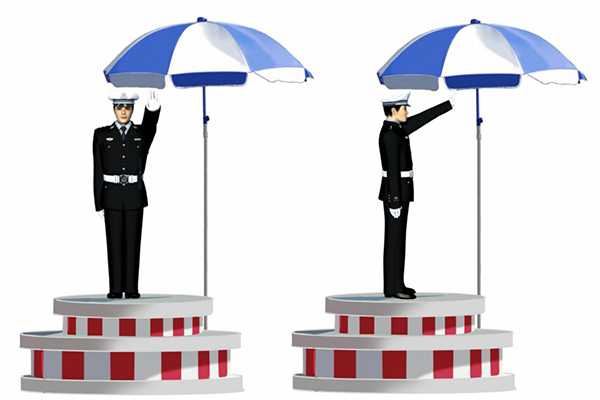
Stop Signal
Left arm raised straight up overhead at a 45-degree angle with palm facing forward. All vehicles facing the officer must immediately stop before the stop line.
Memory Cue: Left arm raised high above shoulder with open palm forward = STOP immediately.
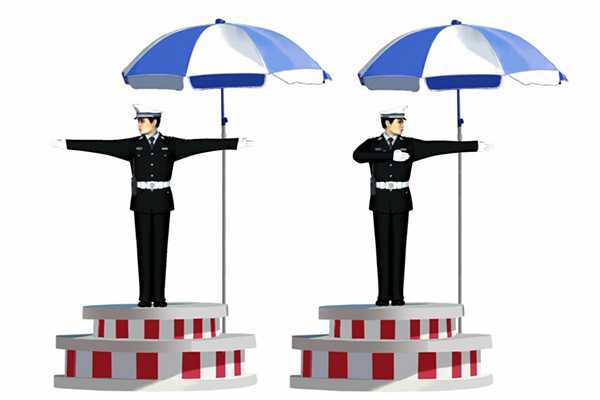
Go Straight Signal
Both arms extended horizontally at shoulder height, then the right arm bends across the chest and swings straight out again.
Memory Cue: Both arms stretched out flat like a T-bar and folding across the chest = GO STRAIGHT.
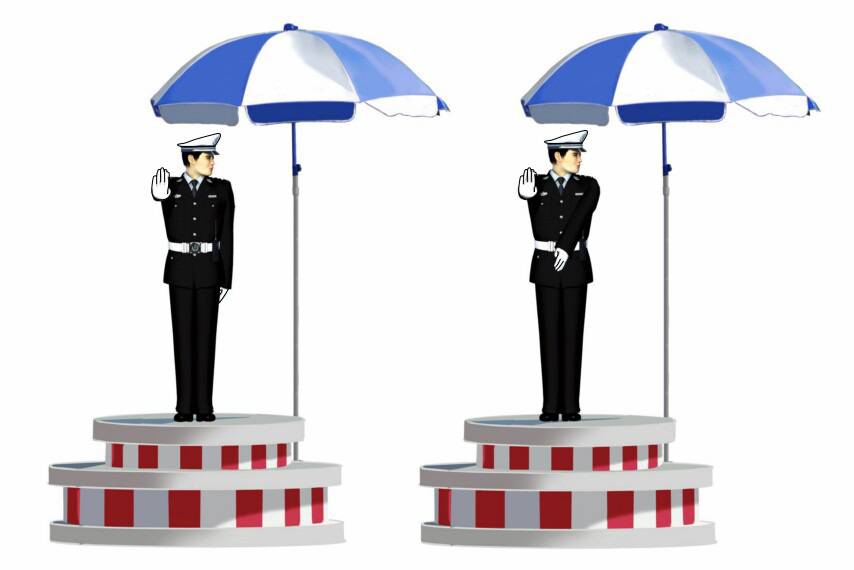
Left Turn Signal
Right arm extended straight forward (stopping opposing traffic), while the left arm swings upward from the lower left side while the officer looks left.
Memory Cue: Officer looks to their LEFT and swings their LEFT lower arm = LEFT TURN.
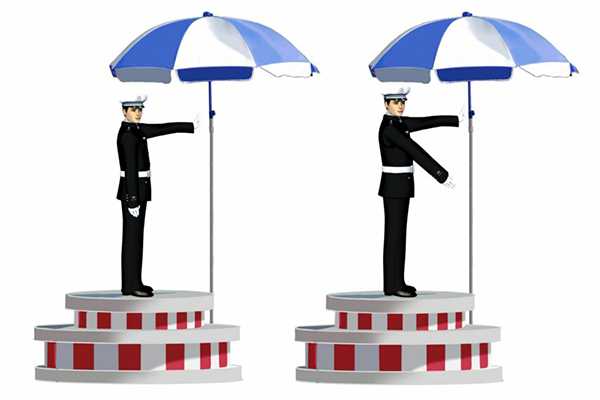
Right Turn Signal
Left arm extended forward at chest height to hold traffic, while the right arm swings inward at waist level as the officer turns their head to the right.
Memory Cue: Officer looks to their RIGHT and swings their RIGHT lower arm = RIGHT TURN.
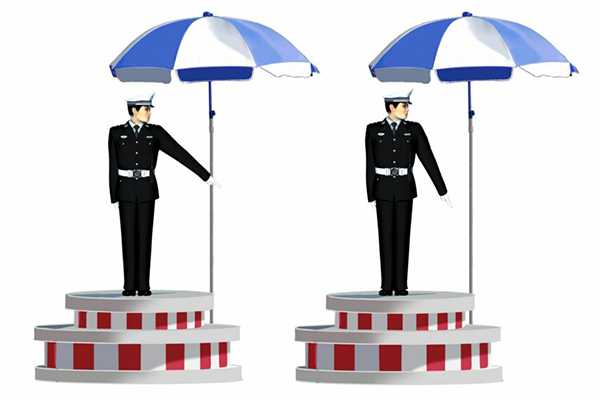
Left-Turn Waiting Signal
Left arm extended diagonally downward at 45 degrees and patted downward toward the center of the intersection. Vehicles move into the waiting box.
Memory Cue: Single LEFT arm patting downward on the left side (right arm stays at side) = LEFT-TURN WAITING.
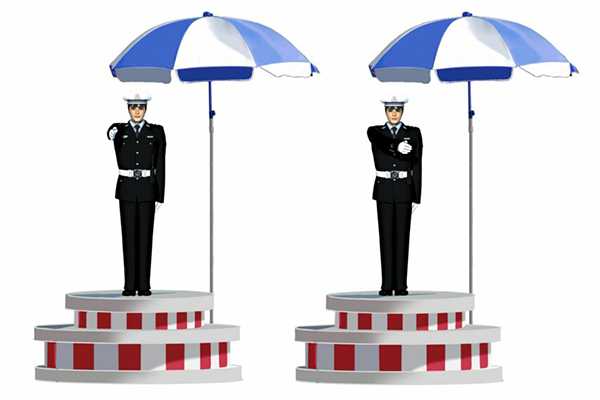
Lane Change Signal
Right arm extended forward with palm facing left, swinging horizontally across the torso from right to left to direct vehicles into an adjacent lane.
Memory Cue: Single right arm sweeping sideways across the chest like wiping a windshield = LANE CHANGE.
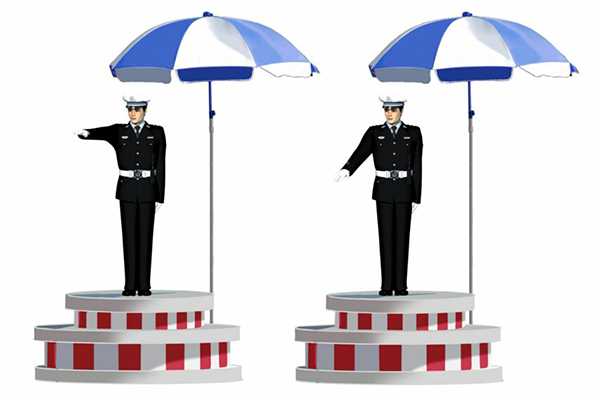
Slow Down Signal
Right arm extended horizontally to the right side with palm facing down, pressing up and down between 90° and 45°.
Memory Cue: Single RIGHT arm patting downward on the right side = SLOW DOWN (opposite hand of Left-Turn Waiting).
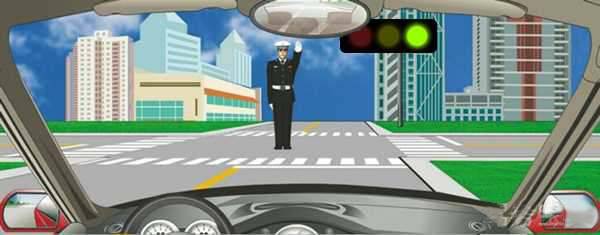
Officer Overriding Green Light (Intersection Rule)
When a traffic officer gives a Stop hand signal even though the overhead traffic light is GREEN, drivers must obey the police officer and stop immediately.
Supreme Hierarchy: Traffic Police Officer > Traffic Lights > Road Signs > Road Markings.
Ready to test your road sign & police signal reflexes?
Jump straight into the 723-question Traffic Signs cockpit or launch a full 100-question timed Subject 1 simulation.